

Jesus' empire-cracking codes
A genius revolutionary

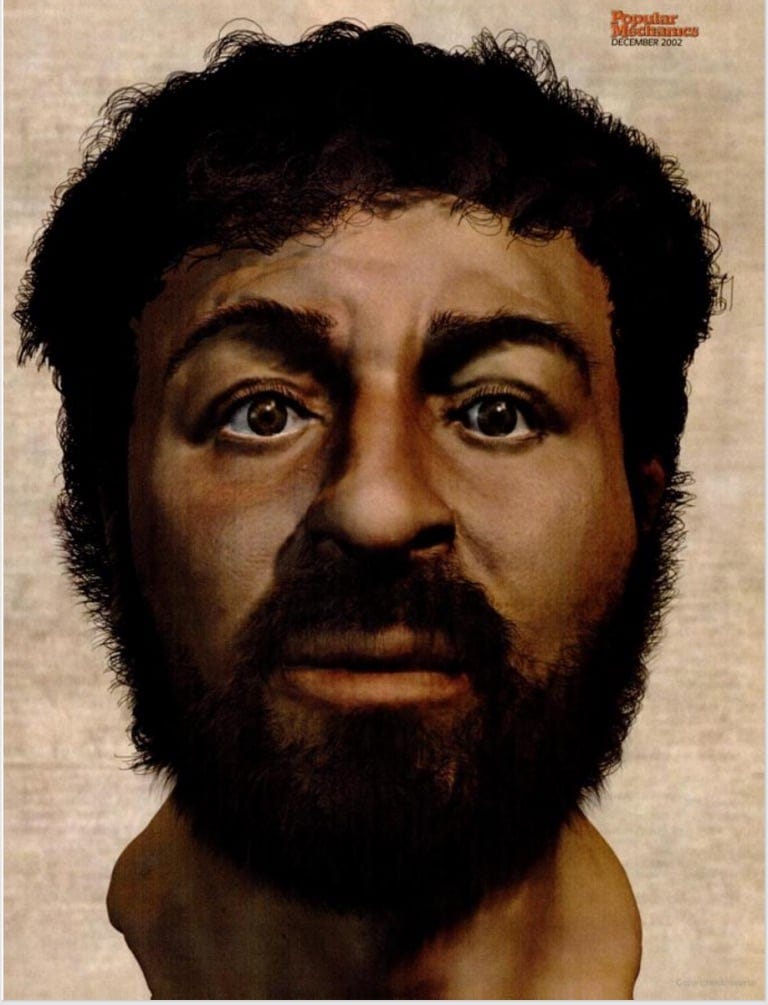
(What Jesus/Yeshua may have looked like)
I was visiting a Baptist church, and the pastor opened her sermon like this: “I used to think Jesus died for our sins.”
Used to? That got my attention. On more than one street corner, I’d been told more than once that Jesus did die for our sins, and if I accepted him I’d be saved.
To be fair, sometimes I was preaching at these street preachers.
The pastor continued, “Now I know that he died for fully living his principles, despite the threat of the Roman Empire.”
That’s stayed with me. Jesus in his occupied homelands, kindling a bonfire of love, catching the attention of the brutal authorities.
Whether Jesus’ name triggers you or warms your heart (or both), whether you think he literally walked the earth, or you see his story as myth layered with history, hear me on this: Jesus was a breaker of empire’s codes, and he did it in a radical way.
Empire’s rules are brutally enforced. Look at the pushback against the civil rights movement in the U.S., land and water defenders at Fairy Creek, Standing Rock, or Wetʼsuwetʼen land, to name some modern examples.
Empires dictate whose rights matter and whose don’t, who is worthwhile and who is disposable, who deserves protection and who can be sacrificed. There are rankings everywhere: rich/poor, beautiful/ugly, pious/impious, high caste/low caste, and on and on.
If you find yourself in some kind of class system, there’s tangible benefit to kowtowing to those on top, and dangers of associating with those at the bottom. This divides people from each other, keeping them from allying. In the US’, ‘whiteness’ was invented to separate poor European settlers from poor African settlers, to prevent them from rebelling together.
It’s easier to rule people who are at odds with each other.
Jesus’ teachings consistently cut across that. Here’s how:
He favored those at the bottom
Prostitutes. Lepers. The poor. The sick.
“The last shall be first.”
“The meek shall inherit the earth.”
Jeshua broke this pattern by consistently favoring those at the bottom. He touched people who were considered untouchable. He ate with people who were considered morally contaminated. He spoke directly to those who had been pushed out of the social and religious centers.
To say “the last shall be first” is not comforting language to an empire. It’s destabilizing. It suggests that the hierarchy itself is illusory or upside down.
He didn’t have enemies
“Love your enemies.”
“Pray for those who persecute you.”
“Forgive them, Father, for they know not what they do.”
In human politics, local and global, we tend to be cast in three roles: villain, victor, and victim. Someone must be blamed. Someone is righteous. Someone is innocent.
There on the cross, instead of seeing himself as a victim and the Romans as villains, Jesus prayed for the well-being of his killers.
From an empire’s perspective, that kind of forgiveness is dangerous — because it interrupts the endless cycle of domination and revenge.
I reckon this can be combined with healthy boundaries and protection, but that’s a discussion for another day.
He was willing to die for his principles
This is the hardest one. Who lives their principles completely, without compromise?
Jesus lived his ideals in public, under occupation, knowing full well the consequences. The Roman Empire had a long track record of crushing anyone who disrupted social order.
Whatever else he may have been — real or fictional, son of God or one of us — Jesus was a breaker of empire’s codes.
This holy-day season, that’s how I’m remembering him.
Appreciating how you elucidate these ways we can reclaim our humanity, dignity and integrity while effectively resisting oppressive systems.